RVN-Bench: A Benchmark for Reactive Visual Navigation
Overview
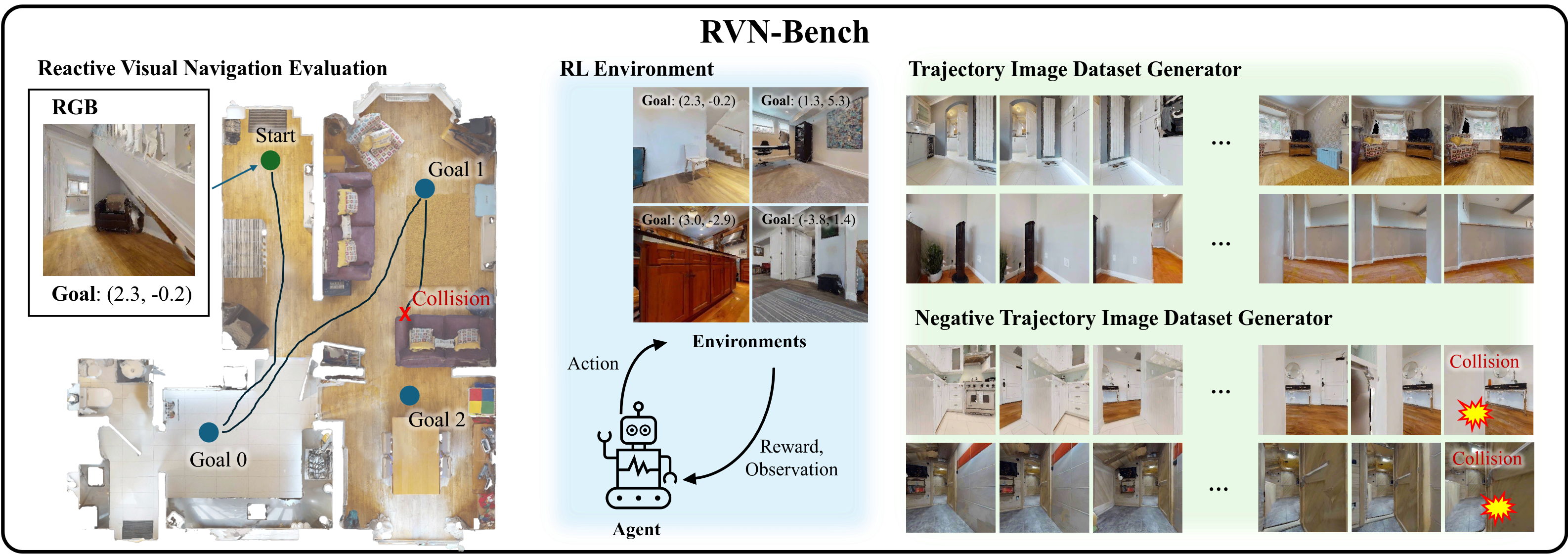
Overview of the RVN-Bench. The benchmark is designed for indoor mobile robots and focuses on collision-aware visual navigation, where an agent must reach sequential goal positions using only visual observations while avoiding collisions. Built upon Habitat 2.0 and utilizing HM3D scenes, it provides high-quality visual observations, an RL environment for training and evaluation, and pipelines for collecting trajectory image datasets, including negative (collision-inducing) trajectories.
Abstract
Safe visual navigation is critical for indoor mobile robots operating in cluttered environments. Existing benchmarks, however, often neglect collisions or are designed for outdoor scenarios, making them unsuitable for indoor visual navigation. To address this limitation, we introduce the reactive visual navigation benchmark (RVN‑Bench), a collision-aware benchmark for indoor mobile robots. In RVN‑Bench, an agent must reach sequential goal positions in previously unseen environments using only visual observations and no prior map, while avoiding collisions. Built on the Habitat 2.0 simulator and leveraging high‑fidelity HM3D scenes, RVN‑Bench provides large‑scale, diverse indoor environments, defines a collision‑aware navigation task and evaluation metrics, and offers tools for standardized training and benchmarking. RVN‑Bench supports both online and offline learning by offering an environment for online reinforcement learning, a trajectory image dataset generator, and tools for producing negative trajectory image datasets that capture collision events. Evaluations demonstrate that policies trained on RVN-Bench generalize effectively across unseen simulated environments. Furthermore, initial physical experiments using a Jackal UGV indicate promising sim-to-real transfer.
Comparison with Prior Benchmarks
TABLE I
Comparison of Visual Navigation Benchmarks.
| Benchmark | Goal Type | Domain | Realistic Visual Rendering | Detect Collision | Lifelong Evaluation | Dynamic Obstacles |
|---|---|---|---|---|---|---|
| CARLA | High-level command | Autonomous driving | ✓ | ✓ | ✓ | |
| MetaUrban | Point | Outdoor | ✓ | ✓ | ||
| Habitat Challenge | Point, object, image | Indoor | ✓ | |||
| HM3D-OVON | Language | Indoor | ✓ | |||
| GOAT-Bench | Object, image, language | Indoor | ✓ | ✓ | ||
| HabiCrowd | Point, object | Indoor | ✓ | ▲ | ✓ | |
| RVN-Bench (Ours) | Point | Indoor | ✓ | ✓ | ✓ |
✓: supported; ▲: collision detection is partial (pedestrian-only; static obstacles not considered); blank: not supported.
Experiments
TABLE II
RVN-Bench Results.
| Category | Method | Train | Validation | Test | ||||||
|---|---|---|---|---|---|---|---|---|---|---|
| SR1 ↑ | E(G) ↑ | CPK ↓ | SR1 ↑ | E(G) ↑ | CPK ↓ | SR1 ↑ | E(G) ↑ | CPK ↓ | ||
| IL | ViNT-PointGoal | 0.097 | 0.11 | 442.3 | 0.090 | 0.11 | 468.3 | 0.093 | 0.10 | 465.4 |
| NoMaD-PointGoal | 0.758 | 4.01 | 32.5 | 0.752 | 3.69 | 35.7 | 0.751 | 4.52 | 31.0 | |
| NoMaD-Neg | 0.750 | 3.83 | 31.2 | 0.757 | 3.97 | 28.6 | 0.760 | 4.61 | 25.8 | |
| Safe-RL | PPO-Lagrangian | 0.826 | 7.88 | 15.7 | 0.803 | 7.61 | 16.9 | 0.805 | 9.02 | 13.7 |
| RL | PPO | 0.824 | 8.70 | 15.6 | 0.808 | 8.54 | 16.4 | 0.819 | 8.68 | 15.5 |
| DD-PPO | 0.899 | 13.28 | 9.2 | 0.865 | 11.86 | 10.5 | 0.886 | 13.90 | 8.7 | |
| DDPPO-DAV2 | 0.937 | 20.79 | 3.5 | 0.909 | 19.88 | 4.0 | 0.928 | 20.79 | 3.6 | |
BibTeX
@article{rvnbench2026,
  title={RVN-Bench: A Benchmark for Reactive Visual Navigation},
  author={Jaewon Lee and Jaeseok Heo and Gunmin Lee and Howoong Jun and Jeongwoo Oh and Songhwai Oh},
  journal={arXiv preprint arXiv:2603.03953},
  year={2026},
}